
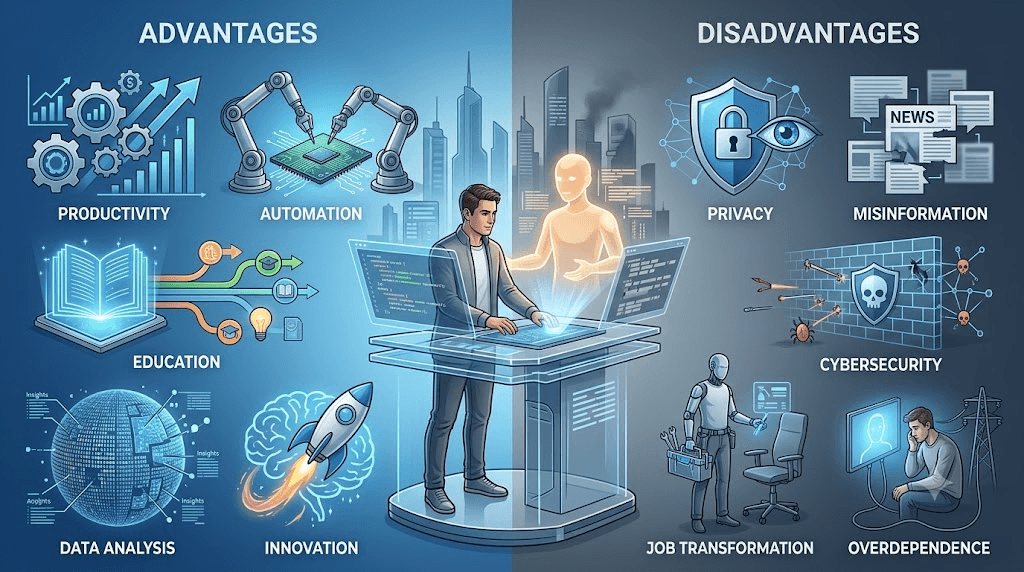
AI: Advantages and Disadvantages of Artificial Intelligence
Artificial intelligence, commonly known as AI, has become an important part of modern technology. From chatbots and virtual assistants to recommendation systems, automated customer support and AI-powered software, these technologies are increasingly being used in everyday life.
AI can process large amounts of information, recognize patterns, generate content and help people complete many tasks faster. Businesses are also using AI for data analysis, customer service, software development, marketing and automation.
However, the growing use of AI also raises important questions. Concerns about privacy, inaccurate information, job changes, cybersecurity and excessive dependence on technology have become part of the wider discussion around artificial intelligence.
Understanding both the advantages and disadvantages of AI can help individuals and businesses use the technology more responsibly.
What Is Artificial Intelligence?
Artificial intelligence refers to computer systems designed to perform tasks that normally require aspects of human intelligence.
Depending on the system, AI can be used to analyze information, identify patterns, understand language, recognize images, generate text or other media, make predictions and assist with decision-making.
Modern generative AI systems can also create content such as text, images, audio and computer code based on user instructions.
AI does not necessarily work like a human brain. Different AI systems are designed for different purposes, and their capabilities and limitations can vary significantly.
Advantages of AI
1. AI Can Improve Productivity
One of the biggest advantages of AI is its ability to automate repetitive tasks.
For example, AI tools can help summarize documents, organize information, generate drafts, analyze datasets or assist with routine customer-support requests.
By handling some repetitive work, AI can allow people to spend more time on tasks that require human judgment, creativity and communication.
2. AI Can Save Time
AI can process large amounts of information much faster than a person could manually in many situations.
For example, an AI system can help organize thousands of records, search through large collections of documents or identify patterns in data.
This can be useful for businesses, researchers, developers, students and other professionals.
However, speed does not automatically mean accuracy. AI-generated information still needs to be checked when accuracy is important.
3. AI Can Support Learning
AI can provide educational assistance in several ways.
Students can use AI tools to get explanations of difficult concepts, generate practice questions, summarize study material or receive help understanding a topic.
AI can also adapt explanations to different levels of knowledge. A complex subject can be explained in simpler language, while more advanced users can request deeper explanations.
Human teachers and reliable educational resources remain important because AI systems can sometimes provide incorrect or incomplete information.
4. AI Can Help Businesses
Businesses can use AI for a wide range of activities.
Common applications include:
Customer support
Data analysis
Marketing assistance
Content creation
Software development
Fraud detection
Workflow automation
Product recommendations
Document processing
For small businesses, AI tools can also make certain tasks more accessible without requiring large teams.
5. AI Can Assist Healthcare
AI is being explored and used in healthcare for areas such as medical image analysis, administrative work, research and decision-support systems.
For example, machine-learning systems can analyze medical images or large datasets to help identify patterns that may be useful to healthcare professionals.
AI should not automatically be treated as a replacement for qualified medical professionals. Healthcare decisions can involve complex individual circumstances and require appropriate clinical oversight.
6. AI Can Improve Accessibility
AI can make technology easier to use for people with different needs.
Speech recognition, automatic captions, text-to-speech, translation and image-description technologies can help people interact with digital information in different ways.
These applications can make websites, software and digital content more accessible.
7. AI Can Help With Data Analysis
Organizations often have more data than people can efficiently analyze manually.
AI and machine-learning systems can help identify patterns, classify information and generate predictions from large datasets.
This can support areas such as business analysis, scientific research, manufacturing and logistics.
The quality of the result still depends on factors such as data quality, system design and appropriate human interpretation.
Disadvantages of AI
1. AI Can Produce Incorrect Information
One of the important limitations of modern AI systems is that they can generate information that sounds convincing but is incorrect.
This can happen when an AI system misunderstands a question, lacks sufficient information or generates an unsupported response.
For this reason, users should verify important information, particularly for subjects involving finance, law, healthcare, safety or other high-stakes decisions.
2. AI Can Affect Jobs
Automation can change the way many jobs are performed.
Some repetitive tasks may increasingly be handled by software, while other jobs may change as employees begin working with AI tools.
At the same time, AI is also creating demand for new skills and roles related to technology, data, AI development, cybersecurity and AI governance.
The effect is therefore not simply about jobs disappearing. In many industries, the nature and skills required for certain jobs may change.
3. Privacy Can Become a Concern
AI systems often work with large amounts of information.
Depending on the product and how it is configured, information entered into an AI service may involve privacy considerations.
Users should therefore understand what information they are sharing and avoid entering sensitive personal, financial or confidential business information into services unless they are authorized and understand the applicable privacy protections.
4. AI Can Be Used to Create Misinformation
Generative AI can make it easier to create realistic-looking text, images, audio and video.
This can be useful for legitimate creative work, but the same technology can also be misused to produce misleading or deceptive content.
AI-generated misinformation can make it more difficult for people to determine whether something they see online is authentic.
Checking information against reliable sources is therefore increasingly important.
5. Cybersecurity Risks Can Increase
AI can be used for legitimate cybersecurity purposes, such as identifying suspicious activity and analyzing security data.
However, AI capabilities can also be misused.
For example, attackers can potentially use automated technologies to create more convincing phishing messages or scale certain malicious activities.
Organizations therefore need appropriate security controls, monitoring and employee awareness.
6. Overdependence on AI Can Be a Problem
If people rely on AI for every task, they may become less likely to develop or use their own problem-solving and critical-thinking skills.
For example, simply accepting an AI-generated answer without checking it can lead to mistakes.
AI is generally more useful when it acts as an assistant rather than an unquestioned authority.
7. AI Can Reflect Bias
AI systems learn patterns from data and other inputs used during their development.
If those sources contain biases or limitations, an AI system can potentially reproduce or amplify them.
This is particularly important when AI is used in areas involving people, such as hiring, lending, education, healthcare or public services.
Testing, monitoring and human oversight can help identify and address these problems.
8. AI Can Increase Digital Dependence
As more businesses and services integrate AI, people may become increasingly dependent on automated systems.
Technical failures, incorrect outputs or system outages can therefore affect workflows that previously relied more heavily on human processes.
Organizations should consider backup procedures and human oversight for important operations.
AI Advantages vs Disadvantages
AdvantagesDisadvantagesCan improve productivityCan generate incorrect informationSaves time on repetitive tasksCan change employment patternsSupports learningCreates privacy concernsHelps businesses automate workCan contribute to misinformationAssists data analysisCan introduce cybersecurity risksCan improve accessibilityCan create overdependenceSupports scientific and healthcare workCan reproduce bias
How Should People Use AI?
The most useful approach is to treat AI as a tool that supports human work, rather than assuming that every AI-generated result is automatically correct.
Users should:
Verify important information.
Protect private and confidential data.
Check AI-generated content before publishing it.
Use reliable sources for important claims.
Keep human oversight for high-impact decisions.
Understand the limitations of the AI tool being used.
Avoid using AI to create deceptive or harmful content.
Businesses should also establish appropriate policies for data protection, security, human review and responsible AI use.
Final Thoughts
Artificial intelligence offers significant opportunities to improve productivity, learning, accessibility, research and business operations. At the same time, it introduces challenges involving accuracy, privacy, employment, misinformation, cybersecurity and human dependence.
The technology itself is neither a complete solution nor a replacement for human judgment. Its value depends largely on how it is designed, deployed and used.
As AI becomes more common, learning both its capabilities and its limitations will become increasingly important for individuals, businesses and society.