Best AI for React.js in 2026: Cursor vs Claude Code vs Codex
React.js development has changed significantly with the rise of AI coding agents. Developers can now use AI not only to generate individual lines of JavaScript or JSX, but also to understand an existing codebase, modify multiple files, run commands, write tests and help debug complex applications.
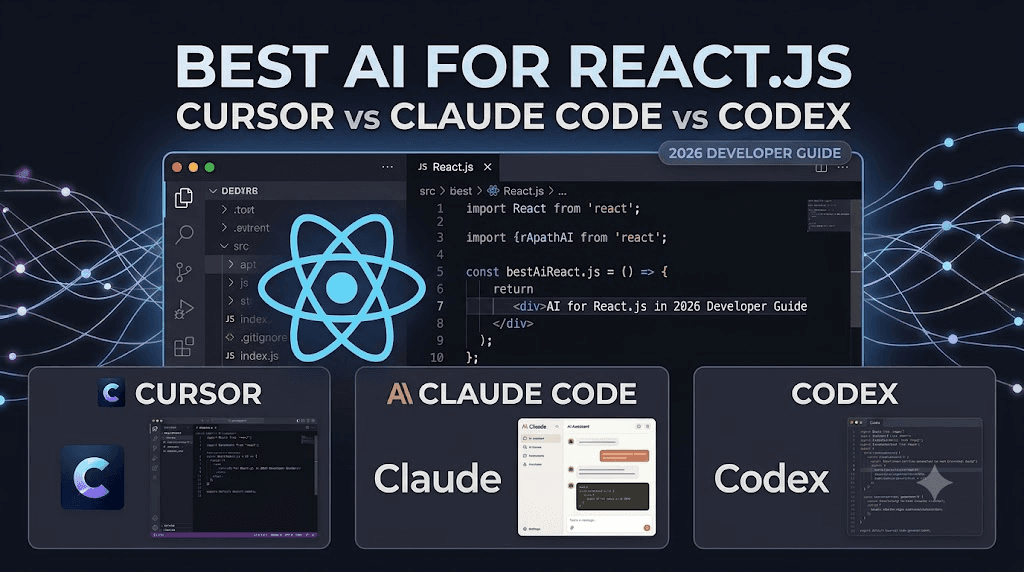
In 2026, three names stand out for React.js development: Cursor, Claude Code and OpenAI Codex. All three can work beyond simple autocomplete, but they are designed around different development workflows. Scrimba
So, which AI is best for React.js right now?
The answer depends on what you are building and how you prefer to work.
Quick Answer: Which AI Is Best for React.js?
For most developers who want an AI-first coding environment, Cursor is one of the strongest all-round choices because it combines an editor, codebase understanding, agentic coding and access to multiple frontier models in one workflow. Cursor's Agent can search a codebase, edit multiple files, run terminal commands and verify changes. Cursor
Claude Code is particularly strong for developers who prefer a terminal-based workflow and want an agent to work directly with the repository. Anthropic describes Claude Code as an agentic coding tool that can explore codebases, plan changes, write tests, fix bugs and commit code. Anthropic
OpenAI Codex is another strong option for complex software-engineering work. It can be used through different interfaces including IDEs, CLI and web-based workflows, and is designed for writing, reviewing and debugging code. OpenAI
There is therefore no universal winner for every React developer.
1. Cursor: Best All-Round AI Coding Environment
Cursor is an AI-first code editor built around agentic development.
Instead of only suggesting the next line of code, Cursor Agent can understand a development task, search through the project, edit multiple files, run terminal commands and check the result. Cursor
This makes Cursor particularly useful for React and Next.js projects where changes often span components, hooks, utilities, API calls, styles and configuration files.
Why Cursor Is Good for React.js
Cursor is useful when you want to work directly inside your code editor while keeping AI close to the code.
Typical React tasks include:
Creating new React components
Refactoring existing components
Fixing JSX and TypeScript errors
Debugging state-management issues
Updating Tailwind CSS
Building responsive interfaces
Refactoring multiple files
Running tests and build commands
Reviewing existing code
Working on larger React or Next.js features
Cursor also supports multiple frontier models, allowing developers to choose a model according to the task. Cursor
Best For
React developers who want an AI-powered IDE and a fast daily development workflow.
2. Claude Code: Best for Repository-Level Work
Claude Code takes a different approach.
It is designed around an agent that works with your terminal and repository. Instead of focusing primarily on inline coding assistance, you give Claude Code a larger task and allow it to inspect the project, plan the work, make changes and verify the result. Anthropic
For example, a developer could ask it to:
Review this React application, find the cause of the slow dashboard, fix the relevant components and run the tests.
Claude Code can then work through the repository rather than limiting the interaction to one component or file.
Anthropic's current guidance also highlights project-specific instructions, skills, plugins and sub-agents for making Claude Code more aware of a team's development standards. Anthropic
Why Claude Code Is Good for React.js
Claude Code can be particularly useful for:
Large React repositories
Refactoring
Debugging
Test creation
Codebase analysis
Multi-file changes
Repository-level tasks
Terminal-heavy workflows
Best For
Developers who are comfortable with the terminal and want an autonomous coding agent working across the repository.
3. OpenAI Codex: Strong Choice for Complex Development
OpenAI Codex is another major AI coding agent.
OpenAI describes Codex as a coding agent for software development that can help developers write, review and debug code. It is available across multiple development environments, including IDEs, CLI and web workflows. OpenAI Developers
Codex is particularly interesting for React developers working on larger projects where the task involves more than generating a component.
For example:
Refactoring a React application
Debugging complex frontend issues
Reviewing a pull request
Adding tests
Understanding an unfamiliar codebase
Implementing a feature across multiple files
Working on long-running engineering tasks
OpenAI has also highlighted Codex usage across frontend, infrastructure, performance engineering and other engineering teams. OpenAI
Best For
Developers who want a powerful coding agent for complex implementation, debugging and software-engineering workflows.
Cursor vs Claude Code vs Codex
FeatureCursorClaude CodeCodexReact developmentExcellentExcellentExcellentAI-first editorYesNo, terminal-firstAvailable through IDEs and other surfacesMulti-file editingYesYesYesCodebase understandingYesYesYesTerminal workflowsYesStrongYesDebuggingExcellentExcellentExcellentRefactoringExcellentExcellentExcellentLarge projectsExcellentExcellentExcellentBeginner-friendly workflowVery goodMore technicalVery goodBest use caseDaily React developmentRepository-level agent workComplex engineering tasks
These tools increasingly overlap in capability, so the difference is often more about workflow, interface and model choice than whether they can perform a particular React task. Scrimba
What About React 19.3?
React itself continues to evolve, which makes keeping AI-assisted development workflows current important.
React 19.3 was released on September 9, 2026. The release made features including View Transitions and Fragment Refs stable and introduced additional improvements to the React platform. React
This is one reason developers should avoid blindly accepting AI-generated React code.
An AI tool may produce code that looks correct while using outdated patterns or missing newer framework capabilities. Developers should still verify generated code against current React documentation and project requirements.
AI Is Not a Replacement for React Knowledge
AI can dramatically speed up development, but it does not remove the need for engineering judgment.
A coding agent can create a component that compiles while still making poor architectural decisions.
For example, AI-generated React code can potentially introduce:
unnecessary client-side rendering
excessive re-renders
large JavaScript bundles
inefficient data fetching
duplicated logic
unnecessary dependencies
accessibility problems
security issues
Vercel has specifically published React and Next.js performance guidance for AI agents covering more than 40 rules across areas such as async waterfalls, bundle size, server-side performance, data fetching and rendering optimization. The guidance is packaged so coding agents including Codex, Claude Code and Cursor can use it. Vercel
That means the best workflow is not simply:
AI → code → deploy
A better workflow is:
AI → code → test → review → optimize → deploy
Which AI Should React Developers Choose?
The answer depends on the developer.
Choose Cursor If You Want:
An AI-first code editor
Fast daily React development
Visual coding workflow
Multi-file editing
Easy access to different AI models
AI assistance directly inside the editor
Cursor is probably the easiest recommendation for developers who want to make AI part of their everyday coding environment. Cursor
Choose Claude Code If You Want:
Terminal-first development
Repository-level tasks
Deep codebase exploration
Large refactoring tasks
Automated testing and debugging
Agent-based workflows
Claude Code is especially attractive for experienced developers who are comfortable giving an agent larger engineering tasks. Anthropic
Choose Codex If You Want:
A dedicated software-engineering agent
Complex coding tasks
Code review
Debugging
Multi-file implementation
IDE, CLI and web-based workflows
Codex is a strong choice when the task requires more reasoning than simple code completion. OpenAI Developers
What Is the Best AI for React.js in 2026?
There is no single AI that is objectively best for every React.js developer.
For an AI-first editor and everyday React development, Cursor is one of the strongest choices.
For terminal-based repository work, Claude Code is a strong option.
For complex software-engineering tasks, debugging and code review, Codex is another strong choice.
The most effective developers may also use more than one tool. For example, one AI can be used for daily implementation while another is used for code review, debugging or difficult architectural problems.
The important factor is not simply which AI generates the most code. It is whether the tool helps you produce correct, maintainable, tested and production-ready React applications.
Final Verdict
If you are starting with AI-assisted React development today, Cursor is an excellent first choice for everyday development.
If you are an experienced developer who wants a repository-level terminal agent, Claude Code is worth considering.
If your workflow involves complex engineering tasks, code review and debugging, OpenAI Codex is a strong alternative.
Ultimately, the best React.js AI is the one that fits your workflow and that you can properly supervise.
AI can accelerate React development, but the final responsibility for architecture, security, performance and production quality remains with the developer. Vercel has similarly emphasized that developers should leverage coding agents while retaining ownership of what they ship. Vercel