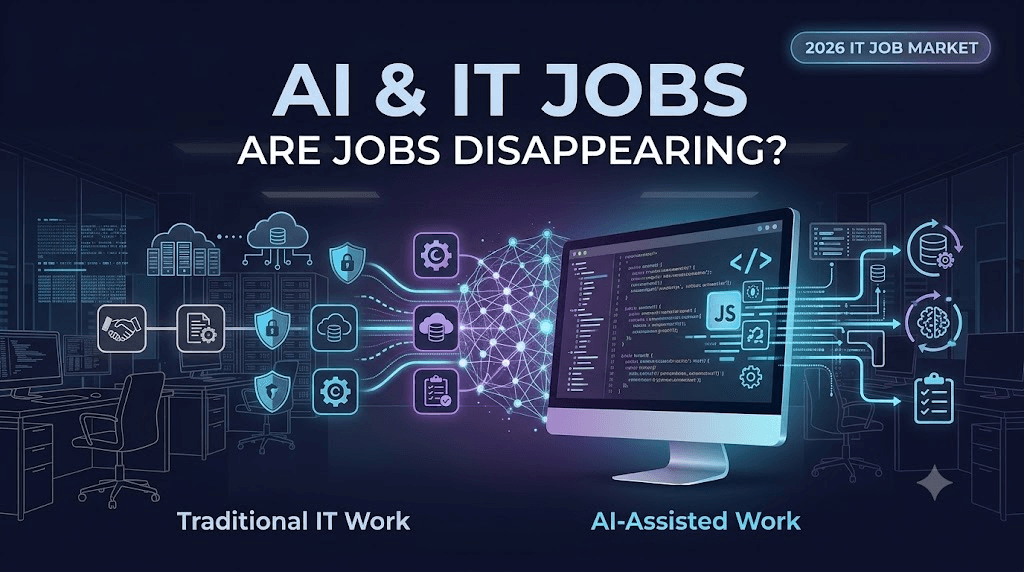
Are IT Jobs Disappearing Because of AI?
Artificial intelligence is changing the way software and technology companies work. AI coding assistants, automation tools and AI agents can now perform tasks that previously required significant amounts of human time.
That has raised a major question for IT professionals and students: Are AI tools actually taking IT jobs?
The answer is more complicated than a simple yes or no.
Current evidence shows that AI is putting pressure on some roles and especially on parts of entry-level hiring, while companies are simultaneously increasing demand for AI-related and hybrid technology skills. In India, recent research points to a moderation in hiring rather than evidence of a large-scale collapse in IT employment. ICRIER
AI Is Changing IT Jobs, But Not Eliminating All of Them
The impact of AI is being felt most clearly in tasks that are repetitive, predictable or highly automatable.
In software development, for example, AI tools can generate code, explain existing code, write tests, find bugs and help developers complete routine programming tasks faster.
This can reduce the amount of time needed for certain tasks. But it does not necessarily mean that an entire software engineering role disappears.
A developer still needs to understand requirements, architecture, security, performance, business logic and the consequences of deploying the generated code.
The result is a shift from writing every line manually toward designing, reviewing, directing and validating software created with AI assistance.
India's IT Sector Is Seeing a Hiring Shift
India's IT industry provides an important example of how AI is changing employment.
A 2026 study by ICRIER, based on a survey of 651 IT firms across 10 Indian cities, found no evidence supporting predictions of massive AI-driven job losses. Instead, the study found a modest but broad-based moderation in hiring, with the strongest impact concentrated at the entry level. ICRIER
The research also found that software-related divisions experienced relatively less moderation in employment compared with other business functions.
At the same time, the study reported productivity improvements from AI adoption, including higher output quality and time and cost savings. ICRIER
This suggests that the Indian IT market is not simply moving from humans to AI. Instead, companies are changing how they combine human workers with AI systems.
Entry-Level IT Jobs Face More Pressure
One of the biggest concerns is the impact on people trying to enter the technology industry.
Stanford's 2026 AI Index reported that employment among workers aged 22 to 25 in occupations with high AI exposure had fallen roughly 16% relative to lower-exposure occupations, after controlling for firm and industry effects. The report noted that the gap began widening in mid-2024. Stanford HAI
This is particularly important for fresh graduates.
Many entry-level technology jobs historically involved tasks such as:
Basic coding
Simple testing
Data preparation
Documentation
Routine analysis
Customer support
Repetitive technical operations
Some of these tasks can increasingly be assisted or automated by AI.
That does not mean graduates cannot find technology jobs. It means the starting skill requirement is changing.
AI Skills Are Increasingly Important in IT Hiring
Indian IT hiring is also moving toward specialised AI capabilities.
A July 2026 report citing Naukri's JobSpeak data said AI hiring within India's IT sector increased 16% year over year in June 2026, while overall IT job listings declined 3%. The divergence suggests that companies are becoming more selective and increasingly looking for specialised AI capabilities. Business Standard
This creates an important distinction.
The problem may not simply be:
“There are no IT jobs because of AI.”
It may increasingly be:
“There are fewer opportunities for certain traditional IT skill sets, while demand is growing for people who can work effectively with AI.”
Software Developers Are Not Simply Being Replaced
Software development is one of the professions most directly affected by AI coding tools.
Developers can now use AI to generate components, refactor code, create tests, investigate errors and accelerate development.
However, software engineering remains a difficult field because real-world applications involve requirements, architecture, security, integrations, databases, infrastructure and business constraints.
A 2026 CIO report ranked software engineering among the difficult IT roles to fill and highlighted growing demand for engineers who can combine strong software skills with AI capabilities. CIO
That points toward a different future for developers.
Instead of competing against AI purely on typing speed, developers increasingly need to know how to use AI to build better software.
Wipro's AI Strategy Shows How Work Is Being Reorganized
The changing nature of IT work can also be seen at large Indian technology companies.
Wipro said in September 2026 that its AI initiatives had created productivity capacity equivalent to about 20,000 employees. According to the company's CTO, those workers were redeployed into other roles rather than simply being eliminated. Wipro also said more than 100,000 employees had received advanced AI training. Reuters
This is an important example because it shows another possible outcome of automation:
AI can reduce the amount of human effort required for a task without necessarily removing the employee from the company.
Workers can potentially be moved toward higher-value activities, AI implementation, client-facing work or new technology projects.
Which IT Jobs Are More Vulnerable?
Roles containing a high proportion of repetitive and predictable tasks are generally more exposed to automation.
Examples can include:
Routine data processing
Basic content operations
Repetitive testing
Simple technical support
Basic code generation
Manual documentation
Repetitive administrative technology tasks
However, job titles alone do not determine AI exposure.
Two people with the same job title can have very different levels of exposure depending on the complexity and responsibility of their work.
Which IT Skills Are Becoming More Valuable?
The demand for AI-related and hybrid skills is increasing.
CIO's 2026 research identified AI and machine learning, cybersecurity, data science and analytics, business/IT automation and software engineering among important difficult-to-fill technology areas. CIO
For IT professionals, valuable skills increasingly include:
AI and Machine Learning
Understanding AI systems, machine learning concepts, generative AI and AI implementation can open new opportunities.
AI-Assisted Software Development
Developers who know how to use coding agents effectively can potentially deliver software faster while still maintaining engineering quality.
Cybersecurity
AI is creating new security risks as well as new security tools, keeping cybersecurity expertise highly relevant.
Cloud and Infrastructure
AI applications require substantial infrastructure, data systems and cloud platforms.
Data Engineering and Governance
Companies need reliable data, pipelines, governance and controls for AI systems.
Product and Business Understanding
Technical professionals who understand the business problem behind a product can provide value that cannot be reduced to simply generating code.
The Biggest Risk May Be Not Using AI
For IT professionals, the competitive threat may not always be AI replacing the worker.
It may be:
A worker who uses AI replacing a worker who does not.
If one developer can responsibly use AI agents to complete routine tasks faster while spending more time on architecture, testing, security and product decisions, companies may expect teams to become more productive.
This can raise the performance expectations for IT professionals.
What Should IT Professionals Do Now?
The safest response is not to abandon technology careers.
Instead, professionals should focus on becoming more capable with AI while strengthening the skills AI cannot reliably replace on its own.
A practical approach is:
Learn how modern AI coding and productivity tools work.
Use AI for routine development tasks.
Learn to review and validate AI-generated output.
Strengthen system design and architecture skills.
Improve cybersecurity awareness.
Learn cloud and deployment technologies.
Understand databases and APIs.
Build real-world projects instead of relying only on certificates.
Develop communication and problem-solving skills.
Learn how to connect technology with actual business requirements.
What About Freshers?
Freshers face a particularly important transition.
If AI can handle some basic tasks that previously helped companies train junior employees, companies may hire fewer people specifically for those tasks.
That makes practical experience more valuable.
A fresher who can say:
“I built this application, deployed it, connected the database, used AI tools responsibly and can explain every part of the system”
can demonstrate a different level of readiness compared with someone who only knows programming syntax.
Will AI Completely Replace IT Professionals?
There is currently not enough evidence to conclude that AI will eliminate IT professionals as a whole.
The available evidence instead points toward job transformation, selective automation, changing hiring patterns and rising demand for AI-enabled workers.
S&P Global's 2026 research found that AI's employment impact had become modestly negative globally, but it also found that companies were primarily adopting AI for process efficiency and employee productivity rather than explicitly targeting headcount reduction. The report also identified continuing skill shortages in cybersecurity, AI and machine learning, software development and engineering, and data management. S&P Global
That combination is important.
Some jobs and tasks may disappear or shrink.
At the same time, new responsibilities and technology roles can emerge.
The Future of IT Jobs Is Likely to Be Different
The IT industry is entering a period where knowing how to work with AI may become as important as knowing traditional development tools.
The developer of the future may spend less time manually writing repetitive code and more time defining problems, reviewing AI-generated solutions, designing systems, testing applications and making technical decisions.
For companies, the focus may shift from the number of people required to complete a task toward the amount of useful work a human-AI team can produce.
For professionals, that means the goal should not simply be to compete with AI.
The goal should be to become the person who knows how to use AI effectively, safely and intelligently.
Final Takeaway
AI is putting pressure on parts of the IT job market, particularly repetitive work and some entry-level opportunities. But the current evidence does not show that IT employment is simply disappearing.
Instead, the industry is being reorganized.
Some traditional tasks are becoming automated, while demand is growing for professionals who understand AI, software engineering, cybersecurity, data, cloud technologies and business requirements.
For IT professionals, the message is clear: AI skills are becoming part of the job, not necessarily the end of the job.