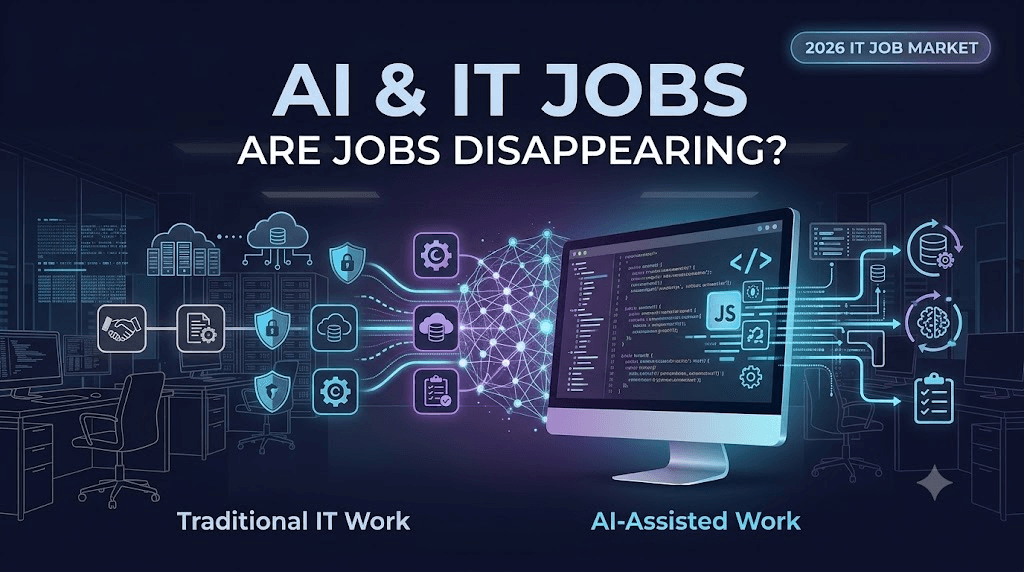
AI vs Software Developers in 2026: Will AI Replace Programmers?
Artificial intelligence is changing software development faster than many developers expected. AI tools can now generate code, fix programming errors, write tests, explain unfamiliar codebases and even complete multi-step development tasks.
Tools such as GitHub Copilot, Claude Code and other AI coding agents have become part of everyday software engineering workflows.
This raises an important question: Will AI replace software developers, or will developers who use AI replace those who do not?
The reality in 2026 is more complicated than either prediction. AI is making several programming tasks faster, but building reliable software still requires human judgment, technical knowledge, testing, security reviews and responsibility.
Recent developer surveys and research provide a clearer picture of where the industry is heading.
How Is AI Changing Software Development in 2026?
AI has moved beyond simple code suggestions. Developers increasingly use AI assistants and autonomous coding agents throughout the software development lifecycle.
Common applications include:
Generating HTML, CSS, JavaScript, Python and other programming code.
Debugging errors and suggesting fixes.
Refactoring existing code.
Writing unit tests and documentation.
Understanding unfamiliar projects and codebases.
Creating database queries and API integrations.
Building prototypes and minimum viable products.
Reviewing code and identifying potential security issues.
The 2026 Stack Overflow Developer Survey found that 83% of respondents use at least one AI tool. Coding assistants or agents are used by approximately 66% of respondents.
This shows that AI is no longer an experimental technology used by a small group of developers. It has become a regular part of modern software development.
AI vs Developers: What Does the Data Say?
The 2026 developer surveys reveal both productivity improvements and continuing concerns about AI-generated code.
According to Stack Overflow's 2026 survey:
FindingResultDevelopers using at least one AI tool83%Using coding assistants or agents65.9%Using general-purpose AI chat tools62.5%Using AI agents or automated workflows26.2%Daily users spending 4+ hours with AI30.9%
The survey also found that 69.3% of respondents use AI for generating code in familiar areas, while 63.8% use it for debugging, troubleshooting or refactoring.
These numbers demonstrate how deeply AI has entered developers' daily work.
However, adoption does not mean developers are ready to trust AI with every important decision.
Only 48% of surveyed respondents indicated that they trust AI when they can easily validate its answers. This highlights the importance of human review.
What Can AI Do Better Than Traditional Programming Workflows?
AI has clear advantages when a task is well-defined and the expected result can be checked.
1. Faster Code Generation
Developers can describe a feature in natural language and ask AI to generate an initial implementation.
For example, instead of manually creating a basic responsive website section, a developer can provide a design description and receive an initial HTML, CSS or React implementation.
The developer still needs to check whether the result matches the design and project requirements.
2. Faster Debugging
AI can analyse error messages, inspect code snippets and suggest possible solutions.
It can help developers understand issues involving JavaScript, database queries, API responses, CSS layouts and application logic.
However, suggested fixes are not always correct. A developer must verify that a change solves the actual problem without introducing new bugs.
3. Faster Prototyping
AI makes it easier to build prototypes and test ideas quickly.
A developer can generate a basic application structure, database schema, API endpoints and user-interface components in significantly less time than traditional manual workflows in suitable tasks.
This is particularly useful for startups and small development teams.
4. Documentation and Testing
AI can generate documentation, suggest test cases and help identify missing edge cases.
This can reduce repetitive work, allowing developers to spend more time on architecture, product decisions and quality assurance.
What Can Human Developers Still Do Better?
AI can generate code, but software development involves much more than writing programming instructions.
Several responsibilities still require substantial human involvement.
1. Understanding Business Requirements
Clients do not always know exactly what they need.
A developer must understand the business model, identify missing requirements, question unrealistic expectations and translate business problems into technical solutions.
AI can help analyse requirements, but it cannot independently guarantee that the proposed solution is the right one for the business.
2. Software Architecture
Choosing the right architecture requires understanding performance, scalability, security, maintainability and future development requirements.
For example, deciding whether an application should use a monolithic architecture or microservices depends on the actual product and its expected complexity.
A technically impressive AI-generated architecture can still be unnecessarily complicated or unsuitable.
3. Security and Data Protection
AI-generated code can contain vulnerabilities.
Developers must understand authentication, authorisation, database permissions, API security, data validation and secure deployment practices.
A working application is not necessarily a secure application.
4. Production Debugging
A small coding mistake can cause serious problems when an application is running in production.
Developers must investigate logs, understand system behaviour, reproduce errors, assess the impact of changes and restore services when something goes wrong.
AI can assist with investigation, but human accountability remains essential.
5. Product and User Experience Decisions
Good software is not simply software that runs without errors.
It must solve a real problem, provide a useful user experience and support the business objectives.
Understanding customer behaviour, making product decisions and balancing technical limitations with business needs require more than code generation.
Does AI Actually Make Developers More Productive?
Research suggests that AI can increase productivity, but the improvement depends on the task and how developers use the tools.
A 2026 Stanford AI Index report summarised studies showing that developers using GitHub Copilot completed 26% more pull requests in one study.
However, the same report highlighted research in which experienced open-source developers became 19% slower when using AI assistance on certain tasks.
This is an important distinction: AI does not automatically make every programming task faster.
MIT Sloan's September 2026 analysis also highlighted a gap between writing more code and delivering more finished software. AI can accelerate implementation, but human-led activities such as reviewing, integrating, testing and releasing software can remain bottlenecks.
The practical lesson is that productivity should be measured by reliable software delivered, not simply by the amount of code generated.
Will AI Replace Software Developer Jobs?
AI is likely to change the responsibilities and skill requirements of software developers. However, current evidence does not support the claim that all programming jobs will disappear.
Some repetitive development tasks may require fewer manual hours. Companies may also build certain internal tools using AI coding agents instead of purchasing external software.
McKinsey's 2026 State of AI survey found that nearly one-third of respondents reported that their organisations had decided against buying at least one software product or feature because they could build it internally using agentic coding tools.
This could change demand for certain types of software development work.
At the same time, businesses still need professionals who can:
Design reliable software systems.
Understand complex business requirements.
Review and maintain AI-generated code.
Build secure applications.
Integrate multiple services and platforms.
Manage databases and production infrastructure.
Take responsibility for technical decisions.
The likely change is not simply fewer developers everywhere. It is a shift in what developers are expected to do.
Which Programming Skills Will Matter Most in the AI Era?
Developers who want to remain competitive should focus on skills that go beyond generating code.
1. Strong Programming Fundamentals
Understanding JavaScript, Python, TypeScript, databases, APIs, data structures and algorithms remains important.
Without fundamentals, developers may struggle to identify incorrect AI-generated solutions.
2. System Design and Architecture
Learn how to design applications, manage data flows, structure backend services and build systems that can be maintained over time.
3. AI Tool Proficiency
Learn to use AI coding assistants, coding agents, automated testing tools and development workflows effectively.
The objective should be to use AI to improve development quality, not simply generate more code.
4. Debugging and Code Review
A developer must be able to inspect AI-generated code, identify hidden problems and verify that the implementation meets requirements.
5. Security and Deployment
Learn authentication, authorisation, cloud deployment, monitoring, database security and production troubleshooting.
These skills become especially important when AI can generate large amounts of code quickly.
6. Communication and Business Understanding
Developers who understand client requirements and communicate technical decisions clearly can contribute beyond implementation work.
AI is most useful as a development assistant when the work is clearly defined and its output can be independently verified.
What Does This Mean for Indian Software Developers?
India has a large software services industry, startup ecosystem and growing community of independent developers.
AI coding tools create opportunities for individuals and small teams to build applications, websites and digital products with fewer manual development hours.
For freelancers and software agencies, this could mean:
Faster website and application development.
More efficient delivery of repetitive tasks.
Lower initial development costs for certain projects.
Greater competition in basic website development.
More demand for complex integrations and reliable production systems.
At the same time, developers who only know how to copy code or create simple templates may face greater competition.
Developers who understand business requirements, architecture, security, performance and user experience will have more ways to demonstrate their value.
Final Verdict: AI Is Changing Developers, Not Making Them Irrelevant
The AI-versus-developer debate is often presented as a competition in which one side must win.
But software development is not just a competition to write code faster.
AI can generate code, automate repetitive work and accelerate development. Human developers provide context, technical judgment, architecture, quality control and responsibility.
The developers who learn to use AI effectively while maintaining strong technical fundamentals will be better positioned to adapt to the changing industry.
The real question is no longer whether developers should use AI. It is whether they can understand, control and take responsibility for the software AI helps them build.
N13K Blogs will continue covering developments in artificial intelligence, programming careers and the future of technology.