Gujarat Farmers Protest 2026: Why Farmers Are Demanding Fair Compensation
Gujarat's farmers are raising concerns over electricity transmission lines passing through agricultural land, inadequate compensation, crop losses, irrigation shortages and increasing farming costs. What began as a protest in Jetpar village of Morbi district has developed into a wider farmers' movement involving several parts of Gujarat.
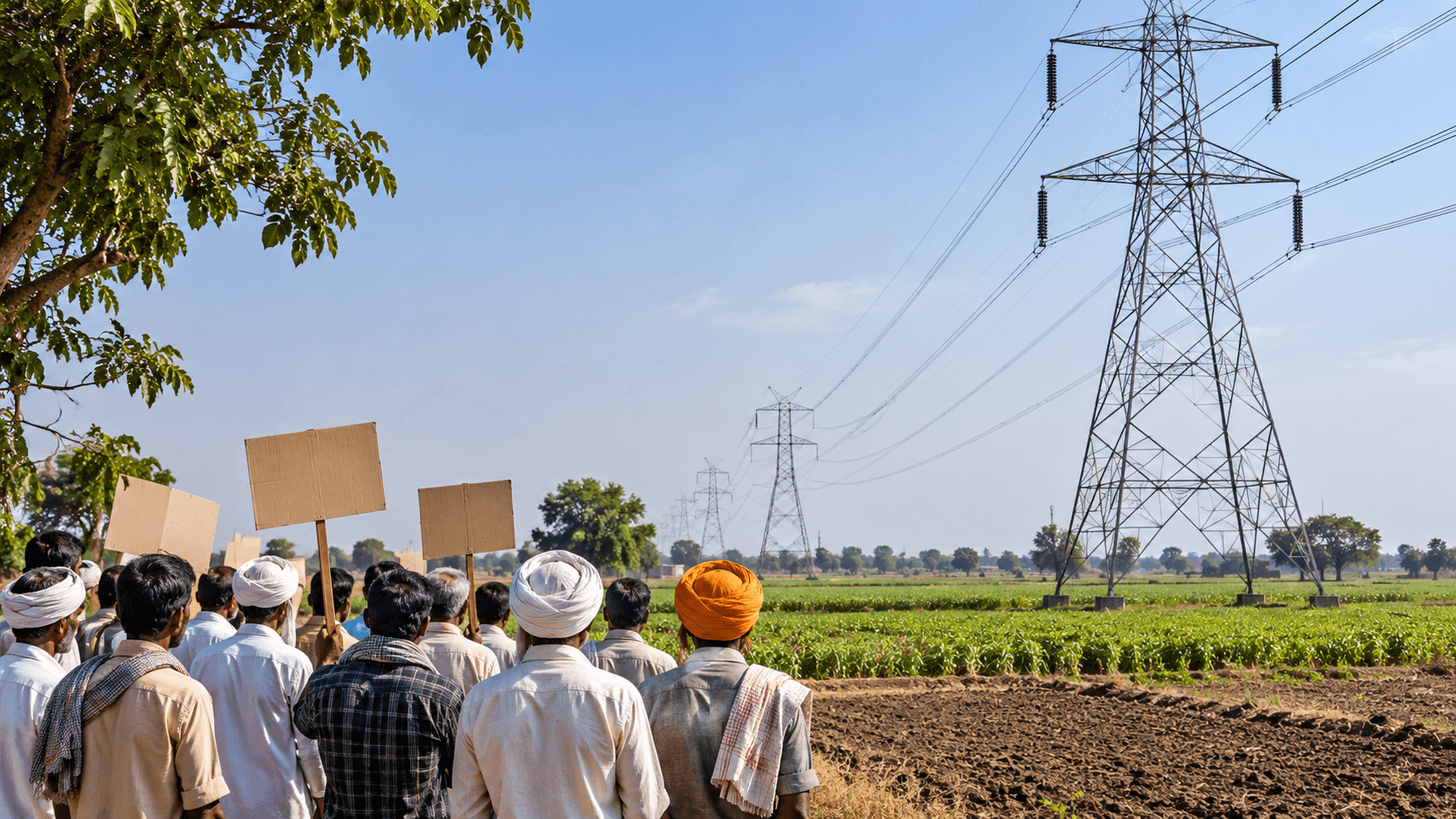
The dispute over power infrastructure has become one of the central issues of the agitation. Farmers argue that transmission towers and overhead electricity corridors affect the use, value and future development of their agricultural land. They want compensation that reflects the long-term impact rather than only the area physically occupied by tower foundations.
At the same time, farmers and agricultural organisations have highlighted wider problems, including insufficient rainfall in parts of Saurashtra, irrigation water availability, crop insurance and rising input costs.
How Did the Gujarat Khedut Andolan Begin?
The current compensation-focused agitation gained momentum in Jetpar village of Morbi district in June 2026.
Farmers began protesting against a high-voltage transmission project connecting the Khavda renewable energy park in Kutch with a switching station at Halvad in Morbi.
The project involves a 765 kV double-circuit transmission line extending approximately 246 kilometres. It is being implemented by Halvad Transmission Limited, a special-purpose vehicle of Adani Energy Solutions.
Farmers objected to the proposed compensation for using their agricultural land for transmission towers and electricity corridors.
An indefinite hunger strike began in Jetpar on June 17. After the Gujarat government announced revised compensation provisions in July, the protesting farmers ended their hunger strike but continued their agitation as a Satyagraha.
The movement subsequently expanded beyond the original village and became a wider campaign over compensation policy and transmission infrastructure.
Why Are Farmers Opposing Electricity Transmission Lines?
Farmers are not necessarily opposing electricity infrastructure itself. Their main concern is the financial and practical impact on agricultural land.
Transmission towers and their associated corridors can affect farming in several ways:
Loss of usable land: Tower foundations occupy agricultural space that may otherwise be used for cultivation.
Restrictions on farming activities: Overhead corridors can limit the cultivation of tall crops and the movement of large agricultural machinery.
Impact on land value: Farmers argue that restrictions can reduce the market value and future development potential of affected land.
Damage during construction: Excavation and installation activities may affect standing crops and farm access.
Long-term restrictions: The impact can continue even after construction is completed.
Farmers argue that compensation should reflect these wider losses, rather than being calculated only on the basis of the physical tower footprint.
What Compensation Has the Gujarat Government Announced?
Following negotiations and protests in Jetpar, the Gujarat government announced revised compensation provisions in July 2026.
The revised policy included:
Compensation for the tower-base area at 200% of the market value determined through the prescribed process.
A revised tower footprint for compensation calculations.
A Market Rate Committee (MRC) to determine the reference market value of affected land.
Advance payment of compensation in a single instalment.
A valuation process involving appointed valuers representing landowners, the transmission service provider and the District Collector.
The revised provisions also cover eligible ongoing transmission-line projects of 66 kV and above, as specified in the government resolution.
However, the announcement did not end the dispute.
Farmers questioned how the actual market price would be determined and whether compensation for the Right of Way (RoW) corridor adequately reflected the restrictions on agricultural use.
The difference between the government's announced formula and farmers' expectations remains a central point of disagreement.
Why Are Farmers Still Unhappy With the Compensation Policy?
The main disagreement concerns how the market value of agricultural land is calculated and how the loss caused by transmission corridors is assessed.
Farmers initially demanded compensation amounting to 400% of the market value of the affected land. The government announced a revised formula based on twice the market value for the tower-base area.
Under the July guidelines, compensation for the Right of Way corridor follows separate percentage-based provisions.
Some farmers have argued that these provisions do not fully account for the long-term impact on land use and resale value.
The Market Rate Committee process has also faced criticism from protesters, who have questioned the valuation mechanism and the time given to landowners to participate.
The government, meanwhile, has maintained that the revised policy provides a structured method for assessing compensation and balancing farmers' interests with the cost of electricity infrastructure.
Why Did the Protest Spread Across Gujarat?
The agitation expanded as farmers from other districts joined discussions and demonstrations.
On July 8, representatives from 12 Saurashtra districts reportedly met in Jetpar to discuss a statewide campaign. Farmer leaders announced plans to organise committees at district, taluka and village levels.
By September, the protest had also involved farmers affected by other transmission projects, including an 800 kV line being developed by Power Grid Corporation of India.
On September 25, more than 9,000 farmers reportedly participated in a demonstration at the Morbi Collectorate, according to The Indian Express.
The growing participation reflected concerns extending beyond one private transmission project to the broader compensation process for electricity infrastructure crossing agricultural land.
What Happened During the September Protests?
The agitation intensified in September after protesters burned effigies of Prime Minister Narendra Modi and Union Home Minister Amit Shah in Jetpar on September 17.
Police booked 21 farmers in connection with the incident.
The Indian Express reported that the protests continued over compensation notices issued to landowners whose fields were affected by the 765 kV Halvad transmission line and an 800 kV transmission project.
Farmers objected to being asked to appear before Market Rate Committees within a short period to nominate land valuers.
The Morbi Collector said the notices were intended to inform landowners that the valuation process had started and that additional time would be available for those unable to attend.
The disagreement highlights the gap between the administration's explanation of the procedure and the concerns raised by affected landowners.
What Are the Other Major Problems Facing Gujarat's Farmers?
The power-line compensation dispute is only one part of the wider agricultural concerns being raised in Gujarat.
At a farmers' rally in Morbi on October 22, Congress leaders highlighted several additional issues affecting farmers in Saurashtra and other regions.
1. Insufficient Rainfall and Drought Concerns
Political representatives and farmer groups have raised concerns about inadequate rainfall in some areas and its impact on sowing and crop production.
They have demanded that affected areas be assessed for drought-related relief.
However, demands for drought declaration and an official government drought declaration are not the same thing. The actual status must be checked against government notifications.
2. Irrigation Water Availability
Farmers have raised concerns about access to irrigation water, particularly in parts of Saurashtra.
The SAUNI (Saurashtra Narmada Avtaran Irrigation) scheme has been part of the discussion, with demands for water to be released into regional dams to support agricultural requirements.
3. Crop Insurance
The availability and effectiveness of crop insurance have also become important concerns.
Farmers and political representatives have called for improvements or restoration of crop insurance arrangements to provide protection against losses caused by inadequate rainfall and excessive rain.
4. Rising Fertiliser and Farming Costs
Increasing costs of fertilisers, agricultural inputs, labour and other farming expenses have added pressure on cultivators.
At the October 22 rally, Congress leaders also raised objections to a reported ₹500 increase in NPK fertiliser prices.
This was a political demand raised at the rally and should be distinguished from an independently verified assessment of the impact across all farmers.
5. Agricultural Debt
Farm loan burdens and demands for loan relief have also featured in the wider protest agenda.
Farmer organisations and political representatives argue that financial pressure becomes more difficult to manage when crop losses, water shortages and rising input costs occur together.
What Happened at the October 22 Khedut Aakrosh Mahasabha?
The Morbi district Congress committee organised a Khedut Aakrosh Mahasabha near Sanala village in Morbi on October 22, 2026.
The announced agenda included:
Compensation for farmers affected by electricity transmission lines.
Financial relief for crop losses.
Demands for drought-related assistance in affected areas.
Better access to irrigation water through the SAUNI scheme.
Restoration or improvement of crop insurance.
Assistance for livestock owners facing fodder shortages.
Farm loan relief and concerns about fertiliser prices.
The rally was organised by the Congress, which announced plans for further agitation programmes across Saurashtra.
These demands represent the position of the rally's organisers and participating political representatives. They should not automatically be treated as a unified resolution adopted by every farmer organisation in Gujarat.
What Is the Gujarat Government's Position?
The Gujarat government announced revised compensation provisions in July after discussions with farmers and other stakeholders.
It said the new approach would use market-based valuation and a committee structure to determine compensation for affected land.
The administration has also explained that the valuation process would involve appointed experts and representatives of different stakeholders.
On the question of changing transmission routes, the Morbi MLA and Minister of State Kantilal Amrutiya was reported as saying that the route would not be changed.
The continuing demonstrations indicate that some affected farmers remain dissatisfied with the implementation and outcome of the compensation process.
What Happens Next in the Gujarat Farmers Movement?
The next phase of the movement is likely to depend on how effectively compensation disputes are resolved and whether farmers receive clarity on valuation and payment procedures.
Important issues to watch include:
Whether affected landowners receive compensation based on the revised policy.
Whether the Market Rate Committee process addresses farmers' objections.
Whether construction work on disputed transmission corridors resumes.
Whether further farmer organisations join the movement.
Whether the government announces additional relief for rainfall-related crop losses and irrigation problems.
The compensation dispute and the wider agricultural demands may continue to develop along separate tracks, even though both are part of the broader debate about farmers' economic conditions in Gujarat.
Conclusion: Gujarat Farmers Demand Fair Compensation and Agricultural Relief
The Gujarat Khedut Andolan of 2026 reflects several interconnected challenges facing farmers.
The Jetpar movement brought attention to the impact of high-voltage transmission infrastructure on agricultural land and the question of fair compensation. Subsequent demonstrations showed that the disagreement was not limited to one project or one village.
At the same time, concerns about rainfall, irrigation, crop insurance, fertiliser costs and agricultural debt have added to the wider pressure on farmers.
The central question is whether policy announcements will translate into transparent valuations, timely compensation and practical relief for affected cultivators.